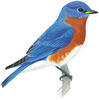
The Eastern Bluebird is a small thrush with a rounded head, plump body and alert posture. One of the small birds founds in open woodlands and grasslands. They are also one of the favourite birds. The Taxonomy of this bird was described by the Swedish naturalist Carl Linnaeus in 1758. Based on the statistics of the NestWatch website, the number of these types of birds is usually increased between March until End of July. Eastern Bluebird has 6.3-8.3(in) length and spans 9.8-12.6(in) across its wings, the weight of this bird is about 27 to 34 gr. These are the property of this species. The two types of this bird have different properties and characteristics.
Types
Male Eastern Bluebird
Male Bluebird has a bright head, and its breast is kind of brownish.
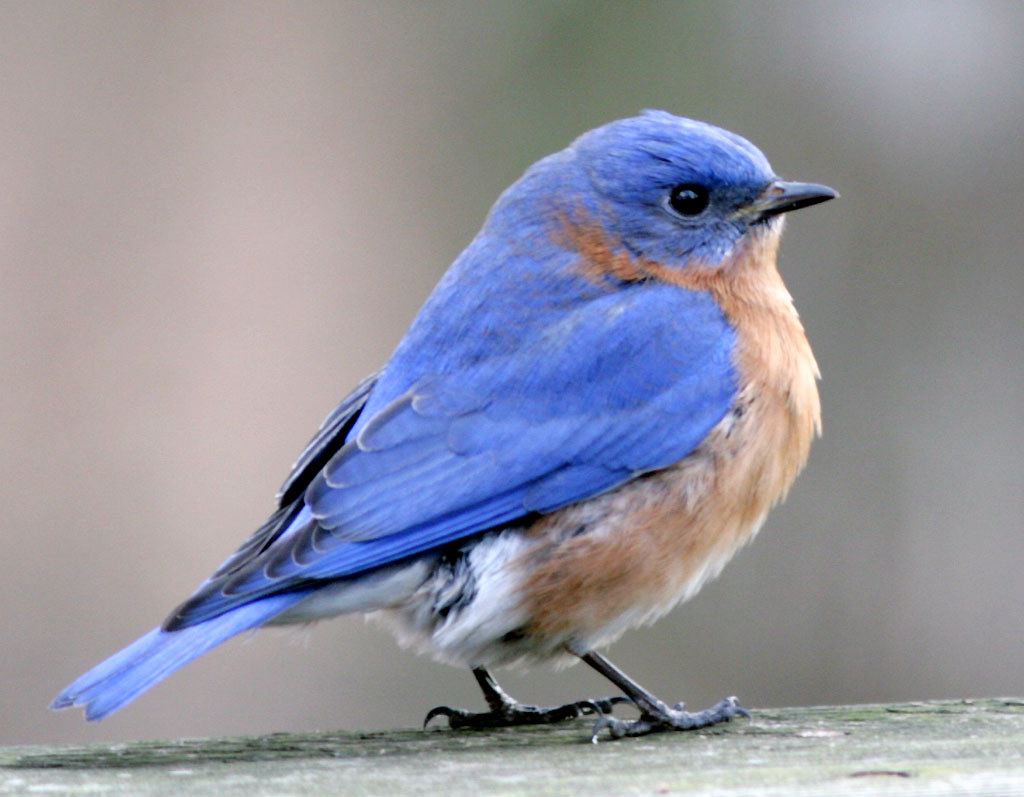 "Eastern Bluebird--male" by cotinis is licensed under
CC BY-NC-SA 2.0
"Eastern Bluebird--male" by cotinis is licensed under
CC BY-NC-SA 2.0


Female Eastern Bluebird
The female bluebirds have a grey head and back. They also have blue wings and tails. Moreover, their breast is lighter than the Male ones and is kind of more orange. Wings and Tails are also somehow blue. Female's weight is lighter than male's.
 "DSC_3019e eastern bluebird--female" by jjjj56cp is licensed under CC BY-NC-SA 2.0

Destribution and Habitats
The Eastern Bluebird is mostly found in the east of southern Canada and southeastern Arizona to Nicaragua. The population of the bluebird grows about 1.5 percent between the years 1966-2015. Most of the Bluebirds are living in an open country around the trees. Their original habitats include open places pine savannas. Bluebirds are also usually live in opening forests, and the populations are mostly across eastern North America and south until Nicaragua. In the west, they have more eggs than the east and south.
Behaviour
The eastern Bluebirds usually live in nest boxes and also in a woodpecker hole. These types of birds are social which, means sometimes they gather in the grumble of hundreds of them. Although, they are local during their breeding seasons. In winter, sometimes they protect a feeding area from each other.
Nest
The nests that they make for themselves are made by
constructed trees and with holes. In addition, the holes have been made by woodpeckers. The nest is also made by
female bluebirds and takes approximately 10 days to complete. The nest is placed in a cavity, mostly in
a natural hollow in the trees. These nests are small, cup-like structures
lined with grass, feathers, animal hair, stems.
(iNaturalist, 2021).
 "Eastern Bluebird Nest"
by astro/nature guy is licensed under CC BY-NC 2.0
"Eastern Bluebird Nest"
by astro/nature guy is licensed under CC BY-NC 2.0

Breeding
Eastern Bluebirds usually mate in the spring and summer. Their child is called broods,
and they have two broods in each season. Each female Bluebird lays 3 to 7 light-blue or sometimes white eggs. It takes about 13 to 16 days. Their baby cannot take care of themselves, and the female ones are also up to seven days after hatching. The fledgling leaves the nest 15 to 20 days after hatching. Their parents work together in raising their young, they also feed with a special diet. The diet is usually could be entirely insects. Some broods help their parents for raising the other broods. Young Bluebirds leave their nest after 18 to 19 days. Young leave the nest at about 18-19 days on average. 2 broods per year, sometimes 3.
(Audubon, 2021).
The colour of fledglings is usually greyish. The Bluebirds are mostly live for 6 to 10 years. The longest record is about 10 years and five months.
 "Eastern Bluebird Eggs" by matthewbeziat is licensed under CC BY-NC 2.0

 "Eastern Bluebird Fledgling" by jonner is licensed under CC BY-SA 2.0

Food
The food of Eastern Bluebird can have different kinds of diets which contain insects and invertebrates. After they finish their food, the remainder is made of berries or other wild fruits. Moreover, it can be great for grasshoppers, etc. Most of the Bluebirds are eating on a high point, such as branches of trees. In the winter, food sources have a direct impact on migrating the Bluebirds. On other hand, the resources will be limited. If bluebirds do remain in a region for the winter, the group and seek cover in heavy thickets, orchards, or other areas in which adequate food and cover resources are available.
(iNaturalist, 2021).
Song
Eastern Bluebirds are usually singing short several phrases. The song that male and female one sing takes about 2 seconds. Females sing this kind of song when they usually see an animal or species that can be dangerous. Most of the Eastern bluebirds song in all seasons of the year. And especially when they brought the food for their family.
The song is from Jonathon Jongsma, CC BY-SA 4.0, via Wikimedia CommonsProtection
Eastern Bluebirds came from the 1700s and 1800s. This source is going to be connected with the migration of settlers. The action of clearing forests has been made by Bluebirds, and it is kind of their habitats. In winter, the pesticides of food can cause a decreasing the number of bluebirds.
Hazards
There are different hazards like freezing and starvation effects on the young ones. The most dangerous threat for Bluebirds is from humans and animals.